Most tyre manufacturing facilities in the GCC, Bangladesh, and South Asia are spending significantly more on compressed air than they need to. The problem is invisible — until someone measures it.
The Audit: What We Were Asked to Investigate
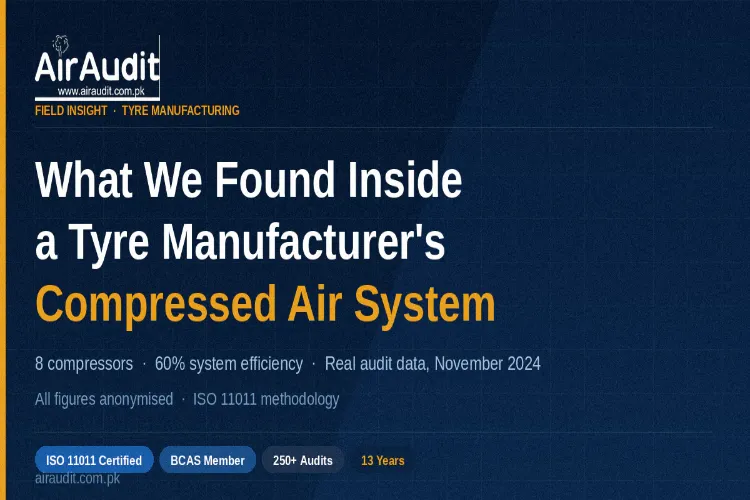
In November 2024, AirAudit conducted a full compressed air system audit at a major tyre manufacturing facility. The plant operated 8 compressors serving production lines across the facility. Management had no recent efficiency baseline. Energy costs were rising. And no one had a clear picture of how much of that energy was actually reaching the machines.
That uncertainty is more common than most plant managers would like to admit — in Pakistan, the UAE, Bangladesh, Saudi Arabia, and across the GCC. Compressed air is the one utility that almost never gets metered the way electricity or gas does. It runs in the background, and losses accumulate silently for years.
Our job was to measure it. Here is what we found.
The Findings: Five Things the Data Showed
The following table presents the core findings from the audit. All data is from the actual report, anonymized to protect client confidentiality.
| Parameter | Finding | Status | What It Means |
|---|---|---|---|
| System Efficiency | 60% | Critical | 40% of all energy consumed by compressors was wasted before reaching any production point |
| Compressor Outlet Temperature | 51 °C | Warning | 11 degrees above optimal — a sign of inadequate cooling, poor ventilation, or internal wear |
| Compressed Air Demand | 31.2 – 42.1 m³/min | Warning | Significant swing between minimum and peak load with no demand-side controls managing the gap |
| Moisture Contamination Risk | HIGH | Critical | Dryer capacity was insufficient relative to peak flow — risking product quality and pneumatic tool damage |
| Leakage Estimate | TBD | Pending | A dedicated leak detection survey was recommended as the next step — leakage was suspected to be significant |
What These Numbers Actually Mean for Your Energy Bill
A 60% system efficiency figure means the plant was paying for 100 units of compressed air energy and receiving the useful benefit of only 60. The remaining 40 units were dissipated as heat, wasted through leaks, or lost to pressure drops across a poorly designed distribution network.
In a facility running compressors around the clock — as most tyre plants do — that translates to a substantial and entirely preventable electricity cost. In regions where industrial electricity tariffs are high, such as the UAE, Saudi Arabia, and increasingly Bangladesh, the financial case for a compressed air audit pays back within months, not years.
Industry benchmark: Based on AirAudit’s experience across 250+ industrial audits in Pakistan and internationally, the average compressed air system operates at 55–70% efficiency. The facility audited here was within that range — but at the lower end. Every percentage point of efficiency improvement represents direct cost reduction.
The outlet temperature reading of 51°C is a particularly important flag. Optimal operating temperature for most industrial compressors is 38–40°C. Running 11 degrees above that range silently erodes compressor lifespan, increases oil consumption, and reduces the efficiency of downstream air treatment equipment including dryers and filters — which is precisely why the dryer capacity in this facility was insufficient at peak load.
Why This Matters for Manufacturers in the GCC and Bangladesh
The Global Regulatory Direction
ASHRAE 90.1-2022 — the leading US energy efficiency standard — now includes Section 10.4.6, the first time compressed air has been mandated in a major international building and industrial standard. It requires monitoring, leak testing, part-load efficiency controls, and pipe sizing specifications.
Similar regulatory momentum is building across the GCC, with Saudi Arabia’s Vision 2030 energy efficiency targets, the UAE’s industrial sustainability regulations, and Bangladesh’s growing compliance requirements for export-oriented manufacturers.
AirAudit has been delivering this standard of measurement and compliance for over 13 years.
For tyre manufacturers, rubber processors, and allied industries in the Gulf and South Asia, the pressures are converging simultaneously:
- Rising industrial energy costs across UAE, KSA, Oman, and Bangladesh
- Increasing ESG and sustainability reporting requirements from multinational customers
- Regulatory movement toward mandatory energy monitoring in industrial facilities
- Competitive pressure to reduce cost-per-unit in a commodity-sensitive industry
- Ageing compressor infrastructure inherited from earlier expansion cycles
AirAudit Now Serves Manufacturing Clients Across the Region
Building on 13 years and 250+ audits in Pakistan, AirAudit’s services are now available to manufacturing clients in the following territories. If your facility runs compressors, the question is not whether losses exist — it is how much they are costing you.
What a Compressed Air Audit Gives Your Facility
An AirAudit compressed air audit, conducted to ISO 11011 standards, delivers the following:
- A verified efficiency baseline— where your system actually stands, measured not estimated
- Quantified leakage losses— the volume and estimated cost of compressed air lost before reaching any end use
- Thermal and pressure profiling— compressor outlet temperatures, pressure differentials, and pipe sizing analysis
- Demand-side assessment— whether your generation capacity matches your actual production load profile
- A prioritized improvement roadmap— ranked by return on investment, not engineering complexity
- Data to justify capital expenditure— when presenting to finance, board, or parent company