There is a metric that most compressor maintenance schedules in Bangladesh do not track. Manufacturers do not print it on the nameplate. Energy consultants rarely mention it. But across 250+ industrial compressed air audits, it is consistently the single largest category of wasted energy in any facility that has been running for more than three to five years.
We call it efficiency depreciation.
For Bangladesh’s manufacturers — textile and RMG composite mills, pharmaceutical plants, food and beverage processors, steel re-rolling lines and cement units — this matters more now than ever. Gas and electricity tariffs have climbed sharply, and for export-facing factories the energy cost embedded in every garment, every tablet, and every tonne is under growing scrutiny from European buyers. Almost all of these plants run on rotary screw compressors — the workhorse of continuous-duty manufacturing — and compressed air, which typically consumes 20 to 35 percent of a plant’s electricity, is exactly where this hidden cost quietly accumulates.
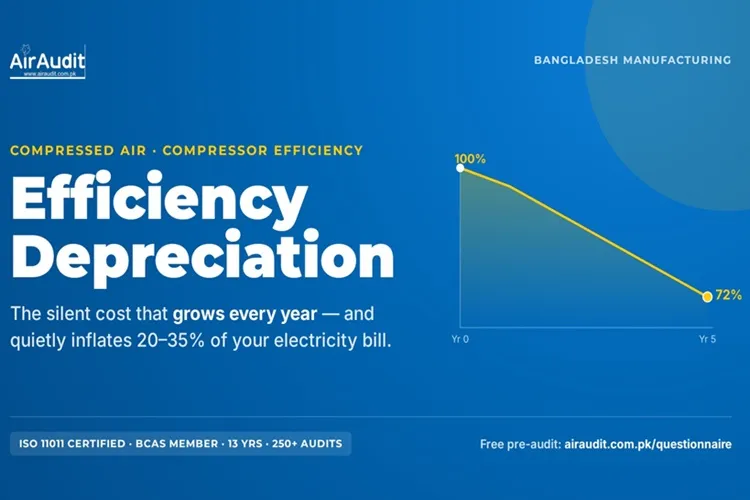
A rotary screw compressor does not hold its rated performance indefinitely. Rotor and clearance wear, bearing degradation, air-oil separator fouling, cooler fouling, and lubricant breakdown all erode the machine’s ability to deliver the rated volume of air, at the rated pressure, for the rated electrical input. As the internal clearances between the rotors — and between the rotors and the housing — open up, more compressed air slips back inside the machine instead of reaching the line, and the specific power, the energy required per unit of air delivered, climbs. The nameplate may say 100 kW for 15 m³/min. After five years of continuous operation without intervention, the same machine might draw 110 kW to deliver just 13 m³/min — a 17 percent fall in output for a 10 percent rise in input. The effective efficiency loss approaches 25 percent.
What makes efficiency depreciation expensive is not the rate of decline. It is the accumulation. A machine that is 5 percent less efficient this year, and 5 percent less again next year, does not simply cost 5 percent more to run. It shifts the entire operating envelope of the system. Downstream pressure drops. Plant teams respond by raising the system pressure setpoint to compensate — which pushes compressor load higher still. Other compressors are forced online more often to meet demand. The whole system drifts upward in energy consumption, year after year, without any single event ever triggering a review.
This is especially acute in Bangladesh’s older composite and spinning mills, many of which run rotary screw compressor fleets installed a decade or more ago — often in hot, poorly ventilated rooms that accelerate the decline.
Consider one audit we conducted at a medical devices manufacturer. We found a rotary screw compressor fleet rated at 334 kW combined that was delivering only 72 percent of its rated volumetric output at the point of use. The compressor room was operating at 35 degrees Celsius — well above the 20 to 25 degree optimal range, a condition familiar to any plant engineer in Dhaka or Chattogram. No flow metering was installed anywhere in the system. The team knew the compressors were ageing, but had no quantified basis for intervention.
Efficiency depreciation alone accounted for 55 percent of the total savings we identified at that site — the largest single category by a wide margin. For a comparable plant in Bangladesh — say a 500 kW compressed air installation typical of a large composite mill in Gazipur or Ashulia — recoverable energy cost on this scale runs into several million Bangladeshi Taka every year. The money is not hypothetical. It is already being spent, month after month, on air the system no longer delivers efficiently.
The reason it goes uncollected is not negligence. It is measurement. A compressor that still starts, still builds pressure, and still feeds the line looks healthy. Its economic decline stays invisible without instrumentation.
The diagnosis requires measurement. A proper ISO 11011 compressed air audit includes a volumetric efficiency test for each screw compressor in the network — comparing actual delivered output against rated output under measured operating conditions. The result is a per-machine efficiency rating that tells you precisely which machines are costing you the most, and whether the economics favour a service intervention, a controls upgrade, or a capital replacement. Just as importantly, it produces an independently verified energy baseline — the documented, instrument-based evidence that European buyers and CSRD-aligned supply chains increasingly expect from their Bangladeshi suppliers.
Compressors that look functional are often economically broken. The only way to know is to measure them.
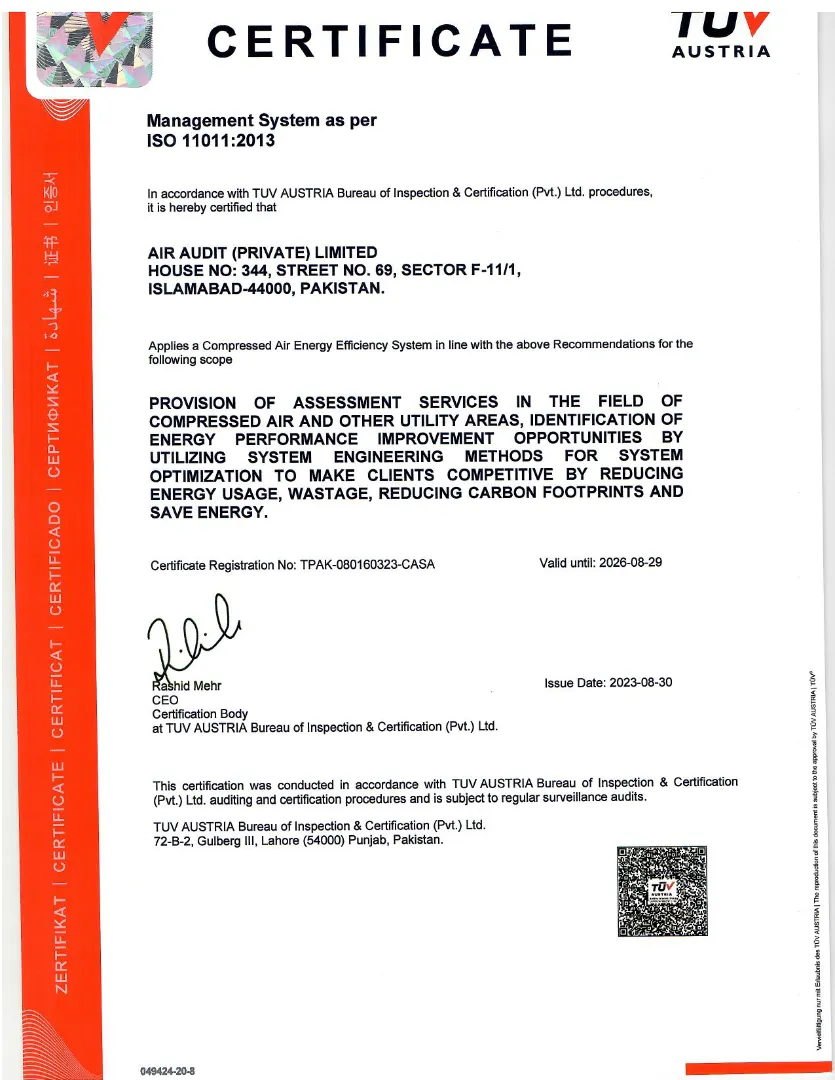
AirAudit (Private) Limited is an ISO 11011-certified, BCAS-member compressed air auditing firm with 13 years of operational history and 250+ industrial audits completed, now serving manufacturers across Bangladesh.
Complete our free pre-audit questionnaire to find out whether your facility has a significant savings opportunity: airaudit.com.pk/questionnaire