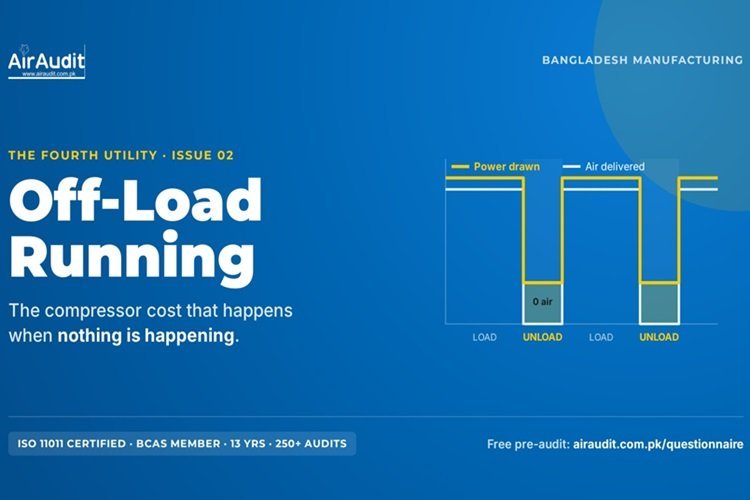
If you have ever walked past your compressor room during a shift changeover or a production pause, you may have noticed the compressors still running. Humming, cycling, doing what looks like nothing — but still drawing electricity.
This is off-load running, and in our audits it consistently accounts for 15 to 25 percent of total compressed air energy cost in facilities that have not actively managed their system demand.
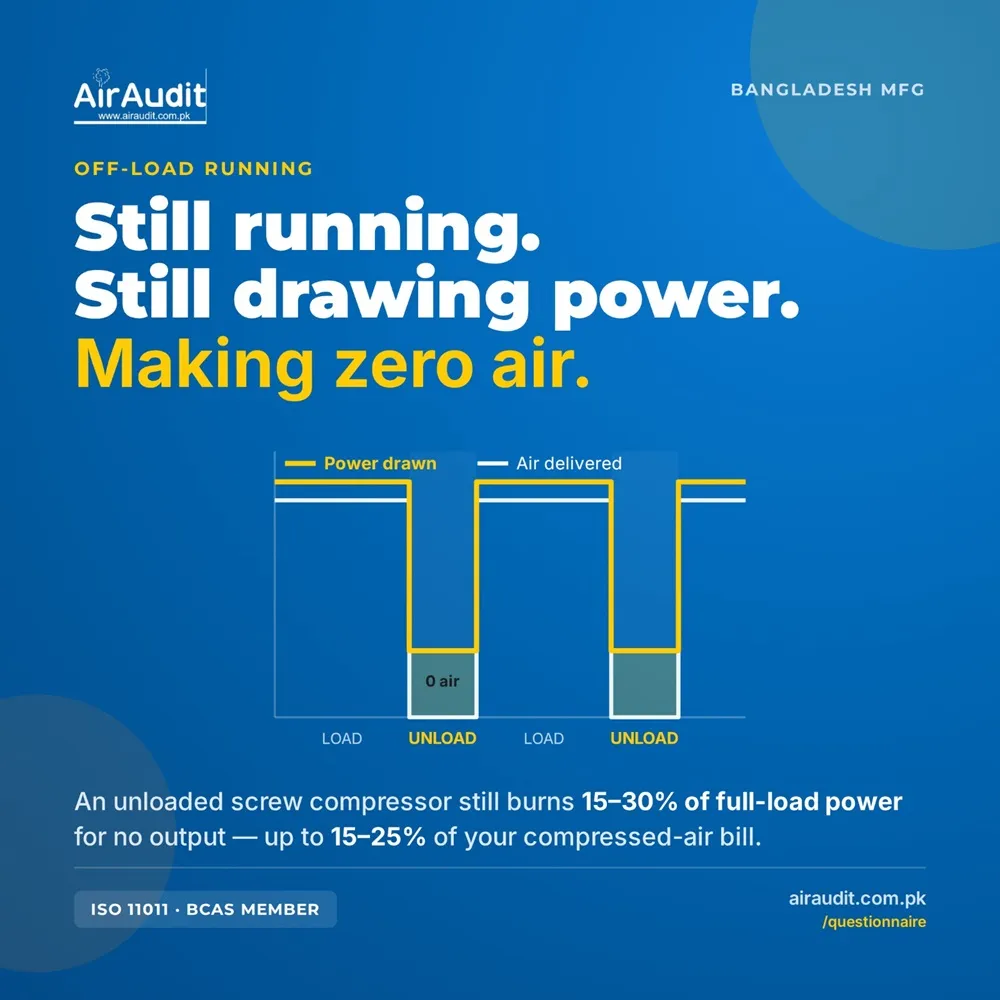
The mechanism is straightforward. Most industrial rotary screw compressors — the dominant type in Bangladesh’s continuous-duty plants — use load/unload control. They switch between loaded (compressing air and delivering it to the line) and unloaded (spinning without compressing) depending on whether system pressure sits within its target band. When demand drops — during breaks, between production cycles, at shift changeover — the compressor unloads instead of stopping.
The problem is that an unloaded compressor is not a free compressor. A rotary screw machine running unloaded still consumes 15 to 30 percent of its full-load power (a reciprocating compressor, 25 to 40 percent). For a 100 kW screw compressor running unloaded two hours per shift, that is 20 to 30 kWh every shift — electricity burned while producing nothing useful.
Across a year, in a composite mill or spinning unit running several compressors against the stop-start rhythm of RMG production, that cumulative waste runs into lakhs of Taka — money spent on air during tea breaks, Friday closures, and the quiet hours between shifts. With Bangladesh’s industrial electricity tariffs climbing, it is one of the most avoidable line items on the entire energy bill.
It is especially common in Bangladesh because of how compressor rooms are built. Fleets are often sized for peak demand and a future expansion that has not yet arrived, so on an ordinary day several machines run part-loaded — or fully unloaded — at the same time. Add the stop-start pattern of garment and textile lines, weekly Friday shutdowns, and night shifts that run on a fraction of daytime demand, and a large share of total compressor hours is spent moving no air at all.
None of this shows up on a walk-through. An unloaded compressor looks busy: it is running, warm, and noisy. The waste only becomes visible when you log loaded and unloaded hours against actual air demand across a representative week. Until then the cost stays invisible — and an invisible cost is one nobody is ever asked to defend.
In our Karachi medical-devices audit, off-load running accounted for 20 percent of total identified savings — the second-largest category after efficiency depreciation.
The solutions exist at every level of investment. The lowest-cost step is simply to shut compressors down during extended non-production periods — obvious, yet rarely done consistently without a written procedure. Next is sequencing control: programming a multi-compressor fleet to stagger its load/unload cycles so the system never carries unnecessary standby capacity. The highest-return step is often a variable speed drive (VSD) retrofit, which removes the load/unload cycle altogether by matching compressor output precisely to demand — particularly well suited to the swings of a textile or RMG production day.
Each carries a different capital cost and a different payback period. A proper ISO 11011 audit measures the off-load loss for your specific system, calculates the savings available at each intervention level, and tells you which investment fits your actual demand profile. It also gives you the independently verified energy baseline that European buyers increasingly expect from their Bangladeshi suppliers under CSRD.
The air you pay for during a shift break is real money. The only question is whether you know how much of it there is.
AirAudit (Private) Limited is an ISO 11011-certified, BCAS-member compressed air auditing firm with 13 years of operational history and 250+ industrial audits completed, now serving manufacturers across Bangladesh.
Complete our free pre-audit questionnaire to find out whether your facility has a significant savings opportunity: airaudit.com.pk/questionnaire