Most factory managers in Bangladesh know their energy bills have been climbing. Electricity tariffs for large industrial consumers have risen significantly over the past five years — increases that have been steep, predictable, and largely beyond anyone’s control. What is within your control, and what most management teams have not yet confronted, is a different kind of energy loss entirely.
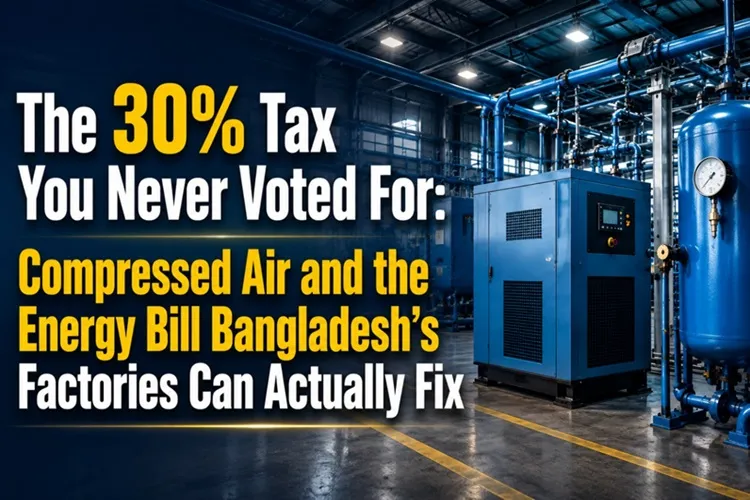
Compressed air — the utility running silently through every pipe in your plant — typically accounts for 20 to 30 percent of a manufacturing facility’s total electricity consumption. In Bangladesh’s most energy-intensive sectors — ready-made garments, spinning mills, pharmaceuticals, and food processing — that figure regularly exceeds 35 percent. For the large composite textile and garment clusters in Ashulia, Gazipur, and Narayanganj, this is not a marginal cost. It is one of the largest single items on the electricity bill.
What makes this remarkable is not the size of the number. It is that compressed air systems are, on average, only 10 to 20 percent efficient at converting electrical energy into useful mechanical work at the point of use. The rest — the overwhelming majority of what you are paying for — is lost to heat, friction, leakage, unloaded running, and pressure drops across distribution networks that were usually designed at the time of construction and never properly measured since.
This is not a criticism of engineering or maintenance teams. Compressed air waste is nearly invisible. It does not trigger a fault alarm. It does not stop a production line. It simply inflates the baseline — the ambient inefficiency that everyone has quietly accepted as the cost of doing business.
The Bangladesh Context Is Specific — and Urgent
The argument for addressing compressed air efficiency has always been financial. In Bangladesh, it is now also regulatory. The European Union’s Corporate Sustainability Reporting Directive and the broader EU Supply Chain Due Diligence framework are placing documented energy performance requirements directly onto the supplier assessment forms that your European buyers are already sending. Several major international brands sourcing from Bangladesh’s RMG sector have added compressed air and utility system efficiency to their factory compliance checklists — not as aspirational targets, but as data fields requiring verification.
Bangladesh exports over USD 55 billion in garments annually, with the EU representing the largest single destination. The factories that will retain and expand their EU business over the next three to five years are those that can document their energy performance with credible, independently verified data. Factories that cannot will face growing pressure in sourcing reviews, financing conversations, and sustainability assessments. This is not a future scenario. It is already happening at the top of the supply chain and moving downward.
What the Numbers Actually Look Like
The good news is that compressed air is one of the most improvable energy systems in any industrial facility. The improvements are not theoretical. They are repeatable, measurable, and — in the majority of cases — achievable without major capital expenditure.
The average savings opportunity we identify in a medium to large unaudited industrial facility runs between 15 and 35 percent of the total compressed air energy cost. For a facility running a 300 kW compressor fleet at 6,000 operating hours per year against Bangladesh’s current high-tension industrial electricity tariffs — approximately BDT 9 to 11 per kWh depending on connection voltage — that compressor fleet is consuming between BDT 16 and 20 million in electricity annually. A 20 to 35 percent recoverable saving translates to BDT 3.2 to 7 million per year. Available now. Sitting in the pipes.
For a 500 kW installation — typical for a large composite garment or spinning mill in Gazipur or Ashulia — the same calculation produces savings in the range of BDT 5 to 12 million annually. That is a figure that belongs in a board-level conversation, not a maintenance log.
The Compressor You Almost Bought
In several of our audits, the most valuable finding was not an energy saving — it was the compressor purchase that did not happen. A facility convinced it needed additional compression capacity to meet growing production demand discovered, after a full system audit, that its existing machines were delivering only 68 to 74 percent of their rated output. The shortfall was not a capacity problem. It was an efficiency problem.
In Bangladesh’s current environment — where foreign exchange constraints affect equipment import timelines, and capital expenditure decisions carry real opportunity costs — avoiding an unnecessary compressor purchase of USD 40,000 to 120,000 is a material outcome in its own right. Before any capital expansion of compressed air capacity, a system audit is the only way to know whether the capacity gap is real or manufactured by inefficiency.
Why It Has Not Been Fixed Already
The answer is simple: compressed air waste is not visible without measurement. Unlike a burst pipe or a motor failure, efficiency losses in a compressed air system produce no alarms, no downtime, and no immediate operational consequence. They simply run quietly in the background, adding to the electricity bill line by line, month by month.
The most common response from plant teams is: “our system is running fine.” And in a functional sense, it is. Production is happening. Pressure is adequate. Machines are operating. But ‘running fine’ and ‘operating efficiently’ are not the same statement. In the compressed air systems we have audited across Pakistan and Bangladesh, the gap between those two conditions has averaged 25 percent of total compressed air energy cost.
You cannot manage what you have not measured. And compressed air, in the vast majority of industrial facilities, has never been properly measured.
What an Audit Actually Involves
A certified compressed air audit to ISO 11011 — the international standard for compressed air system assessments — is a structured, instrumented, multi-day site engagement. It is not a walkthrough. It is not a visual inspection. It involves:
- Volumetric efficiency testing on each compressor in the network, comparing actual delivered output against rated output under measured conditions.
- Ultrasonic leak detection across the full distribution network, quantifying the total leak load in kW and BDT per year.
- Pressure and flow measurement at multiple points in the network to identify distribution losses and pressure drop.
- Load profile analysis to identify off-load running, demand management opportunities, and sequencing improvements.
- A written report with costed findings, prioritised recommendations, and a verifiable baseline for ESG reporting — including the CO2 reduction equivalent at Bangladesh grid emission factors.
The audit takes three to five days on-site. The report is delivered within two to three weeks. The first phase of improvements — leak repair, pressure setpoint optimisation, compressor shutdown procedures — can typically be implemented within 30 days of delivery.
The 30% Tax Is Payable. But It Is Also Refundable.
In 13 years of auditing industrial facilities — textiles, pharmaceuticals, food processing, cement, ceramics — we have not completed a single engagement that failed to identify substantial, verifiable, costed savings. Not one. The efficiency losses are always there. The only question is how long they continue to run before someone decides to measure them.
For Bangladesh’s industrial sector — facing rising electricity tariffs, increasing EU compliance requirements, and a competitive export market where documented sustainability performance is becoming a sourcing criterion — the case for a compressed air audit has never been stronger.