Compressed air leaks are the most discussed form of energy waste in industrial facilities. They are also the most underestimated — because the losses are invisible, accumulate silently, and are almost never expressed in monetary terms at the point of discovery.
The standard approach to leaks is to fix them when they are found and consider the job done. The reality is more systematic. Leaks are not random failures. They are the predictable outcome of a distribution system under continuous pressure, with fittings that loosen over time, seals that wear, and drain valves that stick partially open. A facility that identifies and repairs its current leaks without addressing the underlying system conditions will have rebuilt most of those losses within twelve to eighteen months.
The economic argument for a structured leak management programme begins with measurement.
Compressed air flow loss through a leak is calculated from the orifice size and system pressure. At 7 bar (approximately 100 PSI), a 1mm diameter leak loses roughly 1.3 litres per minute. A 3mm leak — the size of a worn fitting — loses approximately 11 litres per minute. Across 28 leak points in a typical medium-large facility, the aggregate loss can reach 50 to 100 CFM or more.
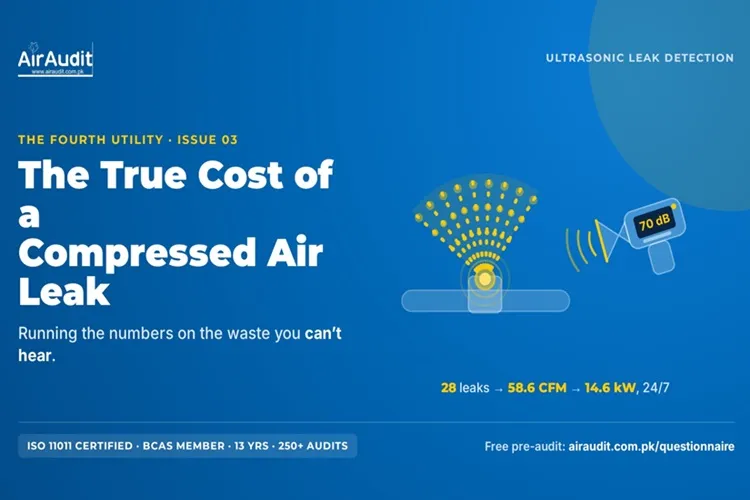
In our Karachi medical devices audit, we identified 28 leak points with a combined loss of 58.61 CFM. Converting that to energy terms: at 7 bar, producing 1 CFM of compressed air requires approximately 0.25 kW of installed compressor capacity. Those 58.61 CFM represented approximately 14.6 kW of continuous electrical load — air being compressed, distributed, and immediately vented to atmosphere.
Running 6,000 hours per year at a standard industrial electricity tariff, that single leak survey identified an annual energy cost running well into seven figures in PKR. From air going nowhere.
The leak locations were telling. Eleven of the 28 were in the compressor room itself — at connections, valves, and drain points that maintenance staff passed every day but never heard at normal background noise levels. Seventeen were in the production area, at FRL connections, pneumatic tool fittings, and partially open drains. The largest single leak — a line connection at one of the compressor units — registered 70 dB on the ultrasonic detector and was losing 4.76 CFM on its own.
None of these were catastrophic. None had triggered a maintenance request. Together, they represented a significant and entirely recoverable annual cost.
A standard Level B audit covering leak detection, location logging, and repair prioritisation typically identifies savings equivalent to 10 to 20 times the audit fee in the first year alone.
The leaks are there. They are measurable. The only question is when you choose to measure them.
AirAudit (Private) Limited is Pakistan’s leading ISO 11011-certified compressed air auditing firm, with 13 years of operational history and 250+ industrial audits completed.
Complete our free pre-audit questionnaire to find out whether your facility has a significant savings opportunity: airaudit.com.pk/questionnaire