Most feed plants can tell you their electricity bill to the rupee. Very few can tell you how much of that bill is compressed air — and almost none can tell you how much of the air they compress never reaches a machine.
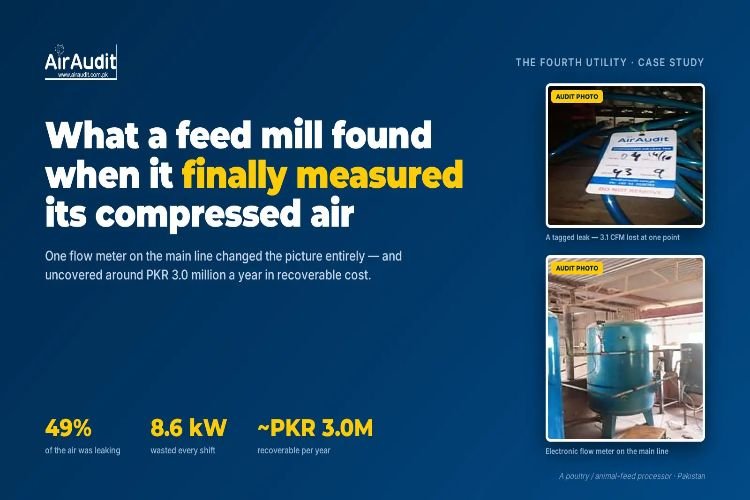
We recently audited a poultry- and animal-feed processor in Pakistan. One rotary-screw compressor, one compressor room, a plant that ran clean and looked well kept. Then we put an electronic flow meter on the main line, and the picture changed.
The headline: nearly half the compressed air the plant produced was leaking out before it did any useful work. Measured leakage was 0.86 m³/min against a peak main-line demand of 1.73 m³/min — roughly 49% of supply. In energy terms, that is 8.6 kW paid for around the clock and delivering nothing. On its own, that leak load costs about PKR 3.0 million a year.
Air is the fourth utility — and usually the least measured
Electricity, gas and water get meters, budgets and someone’s attention. Compressed air rarely does, even though it is often the most expensive utility per unit of useful work in the plant. Here, the compressor was producing air at roughly 10 kW per m³/min, when a well-set-up system of this size should sit closer to 6. That gap is not exotic. It is leaks, pressure set too high, air used for the wrong jobs, and equipment that is quietly undersized.
Where the air was going
We tagged 11 leak points across five areas. The grinder and packing areas alone accounted for more than two-thirds of the loss — the places where hoses get moved, couplings get knocked, and nobody hears a hiss over the machinery. None of these are dramatic failures. They are the ordinary, cumulative leaks that every plant has and no plant measures.
Cleaning with your most expensive air
Like most feed plants, this one used compressed air for blow-down cleaning — sweeping dust off floors, machines and pallets. That air is generated at high pressure and dried before use. Using it to clean is like running a generator to power a broom. A separate low-pressure line, or a simple electric blower, does the same job for a fraction of the cost — and keeps dried, product-contact air for the machines that actually need it.
The things you can’t see until you measure
The audit also found the compressor running at 60°C — it should sit under 40°C — which shortens its life and cuts its output. The air receiver was 1,000 litres where about 3,700 was appropriate, so the compressor cycled more than it needed to. Average pressure drop across the system was 0.9 bar, against a healthy range of 0.1–0.5. Individually, small. Together, they are why the plant paid for 10 kW/m³/min instead of 6.
What it adds up to
Across leakage, compressor efficiency and cleaning pressure, the audit identified about PKR 3.0 million per year in recoverable cost — most of it from fixing leaks and resetting pressure, not from buying new equipment. For a plant this size, an audit like this typically pays for itself within 2–4 months of implemented savings.
The point
This plant was not badly run. It was normally run — which is exactly why the losses were invisible. You cannot manage compressed air you have never measured. The first flow meter usually tells a plant something it did not want to know, and then saves it more than the audit cost.
We do not sell compressors and we do not represent compressor manufacturers, so the only thing we ever recommend is less waste.Want to know what your own compressed air is costing you? Start with our 2-minute questionnaire: airaudit.com.pk/questionnaire