For most manufacturers in Pakistan, the compressed-air system is the utility nobody watches. It runs in the background, it is treated as a fixed cost, and its contribution to the electricity bill is assumed rather than measured. For years that was good enough. It is not good enough anymore.
Two things changed. Electricity stopped being cheap, and ESG reporting stopped being a slogan. Under IFRS S2, a Scope 2 figure is no longer a line a sustainability team can estimate once a year and move on from. It has to be defensible. And a number you cannot show moving in the right direction is a number that invites questions.
That is the gap a repeat audit closes.
The problem with a single number
An ISO 11011 compressed-air audit measures a plant’s system as it actually behaves — leak load, pressure profile, the real demand across a shift, and the specific power it takes to make each unit of air. The first audit is valuable precisely because it replaces assumptions with instrument readings. It typically surfaces an energy-recovery opportunity in the range of 10–25% of the system’s consumption, most of it recoverable without new capital equipment.
But a single audit has a built-in limit: it is a snapshot. It tells you where you stood on one day. It cannot, by itself, tell you whether the savings you implemented actually held, whether new leaks crept back in, or whether your system drifted as production changed. In an ESG context, a snapshot is an estimate wearing better clothes.
What a second audit does
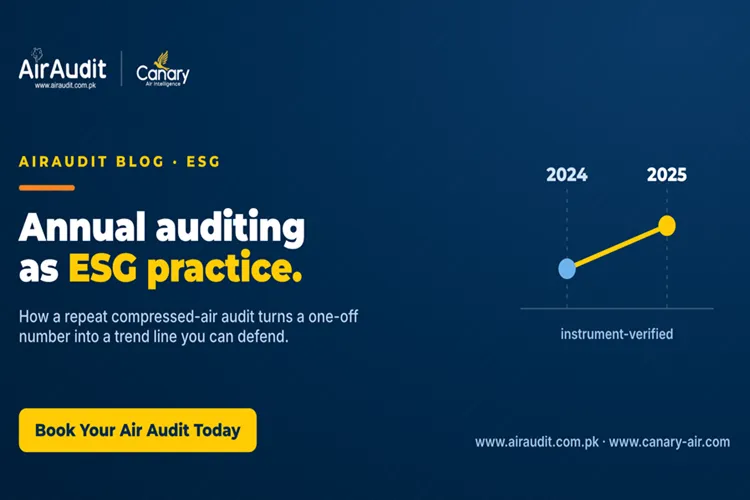
A repeat audit re-measures the same system, by the same method, a year on. That one change — measuring twice — converts a static figure into a trend line. You stop reporting “we identified savings” and start reporting “here is what we captured, here is what held, and here is what remains.”
That is a different quality of evidence. For a sustainability lead, it is the raw material of a credible Scope 2 narrative: a measured baseline, re-verified, with direction. For a CFO, it is proof that an operational decision produced a repeatable return rather than a one-off win. Across our audits, the implemented savings typically recover the audit fee within two to four months — and a repeat audit is how you confirm that the return is still compounding rather than quietly eroding.
The 2025 repeat audit: a trend line, against a rising tariff
Consider a recent example — a major Pakistani terry-towel and home-textiles exporter, a business for whom compressed air is a material slice of electricity cost. The plant was first audited, acted on the findings, and returned in 2025 for a repeat audit.
The repeat did two things a first audit could never do. It verified, with instruments, what the earlier changes had actually delivered — turning last year’s recommendation into this year’s confirmed result. And it reframed the stakes. Over the same period, the plant’s effective electricity tariff climbed from roughly Rs 25 to around Rs 35 per kWh — a rise of about 40%. That matters more than it first appears: the identical volume of wasted compressed air now costs the plant roughly 40% more in rupees than it did a year earlier. A recovery percentage that looked modest in 2024 returns materially more cash in 2025, simply because every wasted unit is dearer.
This is the ESG story with teeth. Not a pledge, not a target for some future year — a measured number, re-measured, moving in a direction the business can defend to a board, a buyer, or an assurer.
Why this is an IFRS S2 discipline, not a marketing exercise
Here is the line worth remembering: Scope 2 without instrument verification is an estimate. With it, it is a baseline. A repeat audit extends that principle across time. It gives a reporting team longitudinal, instrument-verified data for the compressed-air portion of their Scope 2 footprint — the kind of evidence that survives assurance scrutiny instead of collapsing under it.
We are deliberately precise about scope. This is a compressed-air Scope 2 baseline — not full-facility ESG consulting, and not carbon-credit issuance. We measure one system exceptionally well, and we measure it again, so the number you report is one you can stand behind.
The one thing that makes the number trustworthy
There is a reason an instrument-verified baseline carries weight, and it comes down to who is holding the meter. We do not sell compressors and do not represent compressor companies. We are an independent, hardware-neutral, ISO 11011-certified auditor. When we tell a plant its rotary-screw system is leaking a given share of its output, there is no equipment sale riding on the answer. That independence is the whole point: we are the only people in the room with nothing to sell you except the truth about your air.
That is also why the invisible becomes visible. Compressed-air waste doesn’t announce itself — it leaves quietly, on the electricity bill, as margin. A repeat audit is how a manufacturer keeps it from coming back.
Make auditing annual
If your first audit was a one-off, you have a snapshot. If it becomes annual, you have a trend — and under IFRS S2, a trend is what a baseline is made of. For an energy-intensive plant facing tariffs that are still climbing, an annual compressed-air audit is no longer a cost-saving nicety. It is how you protect margin and report Scope 2 you can defend.
Book Your Air Audit Today — complete the questionnaire at www.airaudit.com.pk/questionnaire/ and our team will be in touch. Learn more at www.airaudit.com.pk and www.canary-air.com.