What Happens When You Actually Verify Leakage Repairs
Most compressed-air audits end with a list of recommendations and a projected number. The plant fixes what it can, the report goes in a drawer, and nobody ever measures what actually changed. The projection becomes the story — even though no one went back to check it.
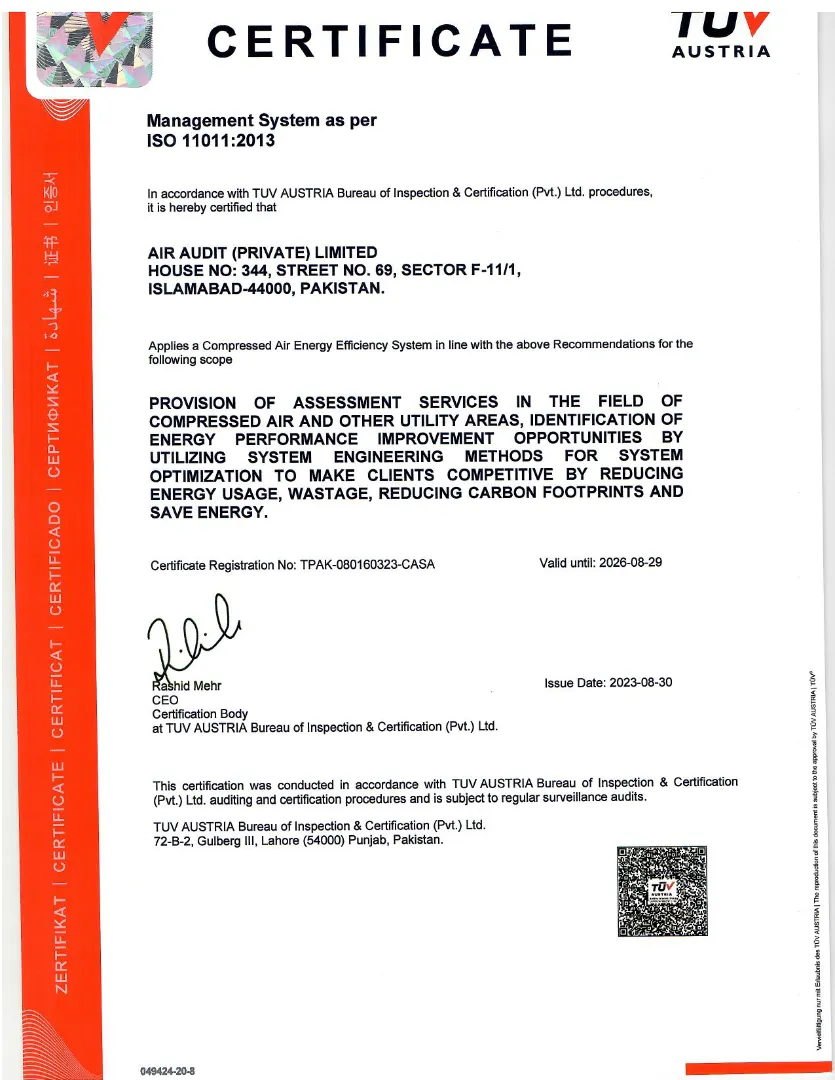
We do it differently. On a recent ISO 11011 audit of a major Pakistani spinning mill, we didn’t stop at finding the leaks. We tagged every one, waited for the maintenance team to repair them, and then returned to re-test each repair on the meter. This is verification — and it is the difference between a number you can defend and a number you hope is true.
Before we say anything else: we do not sell compressors and we do not represent compressor companies. We are an independent, hardware-neutral, ISO 11011-certified auditor. Our only product is the truth about your air system — which is exactly why we’re willing to go back and measure whether the fix worked.
What we found in one unit
Compressed air is the fourth utility — after electricity, water and gas — and it is almost always the most wasteful, because leaks are invisible and silent under plant noise. Using calibrated flow meters, ultrasonic leak detectors and temperature/humidity sensors, we mapped the compressed-air network of a single production unit: compressor room, main lines, trenches, production halls, ring frames, auto-cone, carding, drawing, doubling and blow room.
The result was stark. In that one unit alone, we identified 665.5 CFM of leakage — the equivalent of 118.3 kW of compressor power running around the clock to feed holes in the pipework. At Rs.41/kWh and continuous operation, that is PKR 41.9 million every year, paid for air that never reaches a single machine.
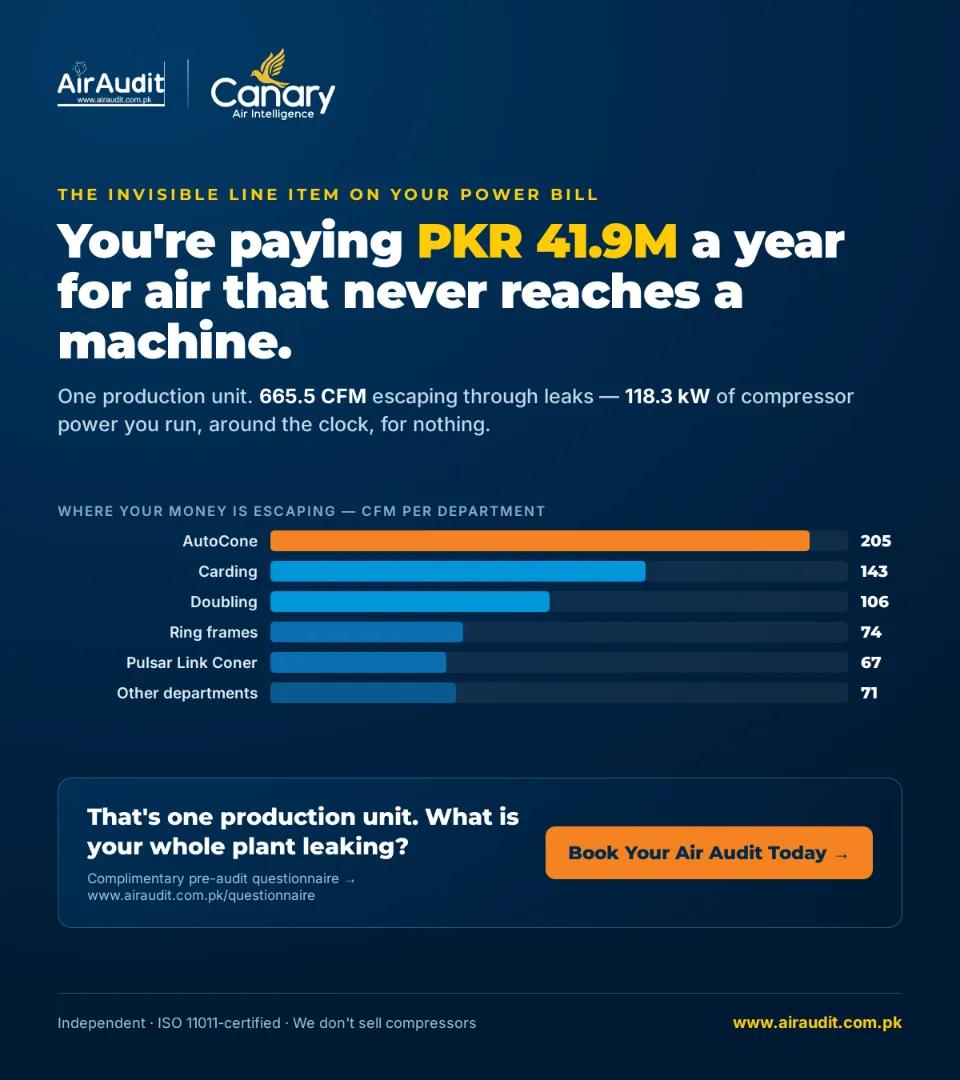
That figure is not a projection. It is a measurement.
The part most auditors skip
Finding leaks is the easy half. Anyone with a detector can tag a fitting and write it down. The hard, honest half is going back after the repairs to confirm what actually got fixed — and what didn’t.
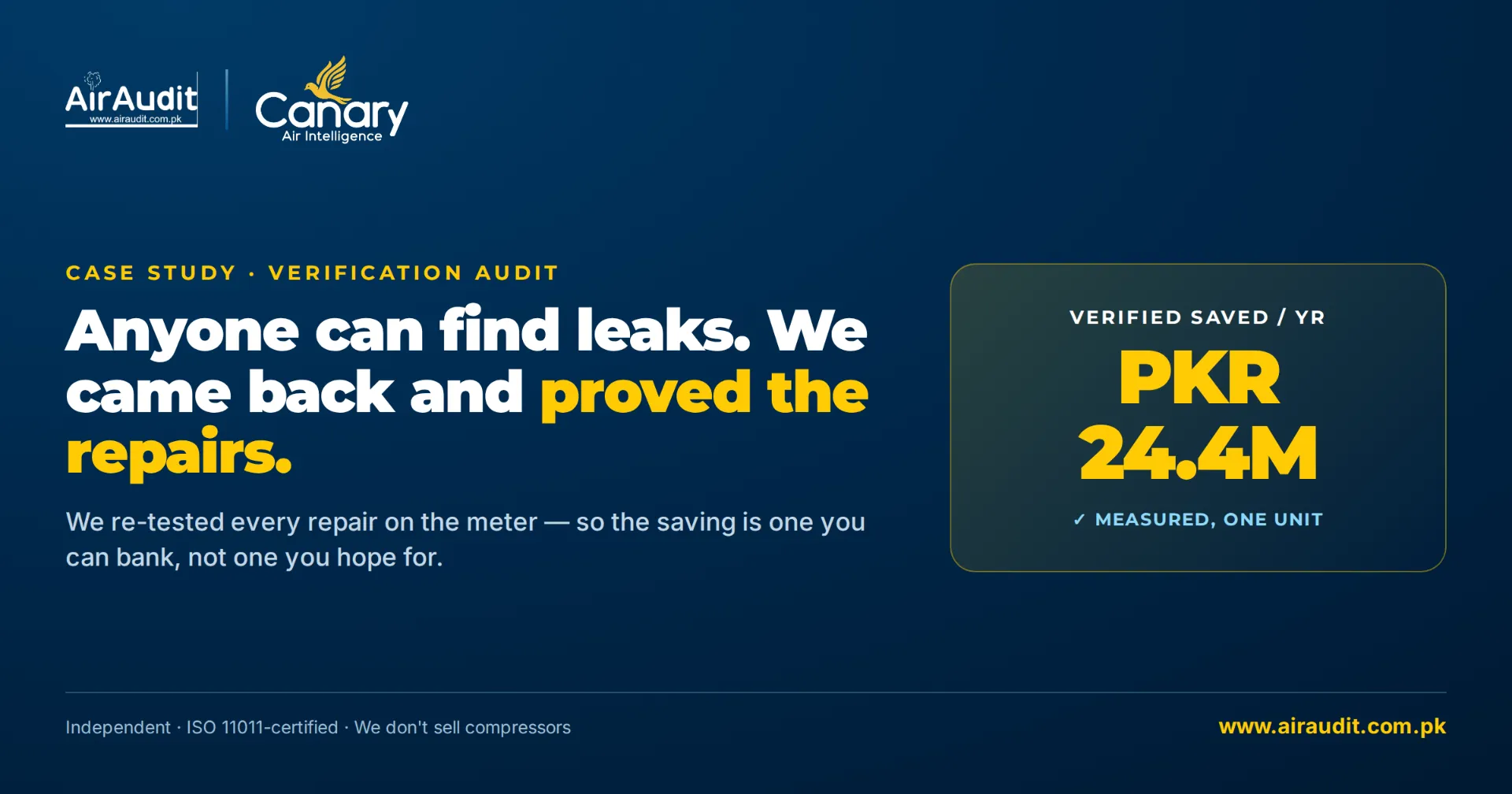
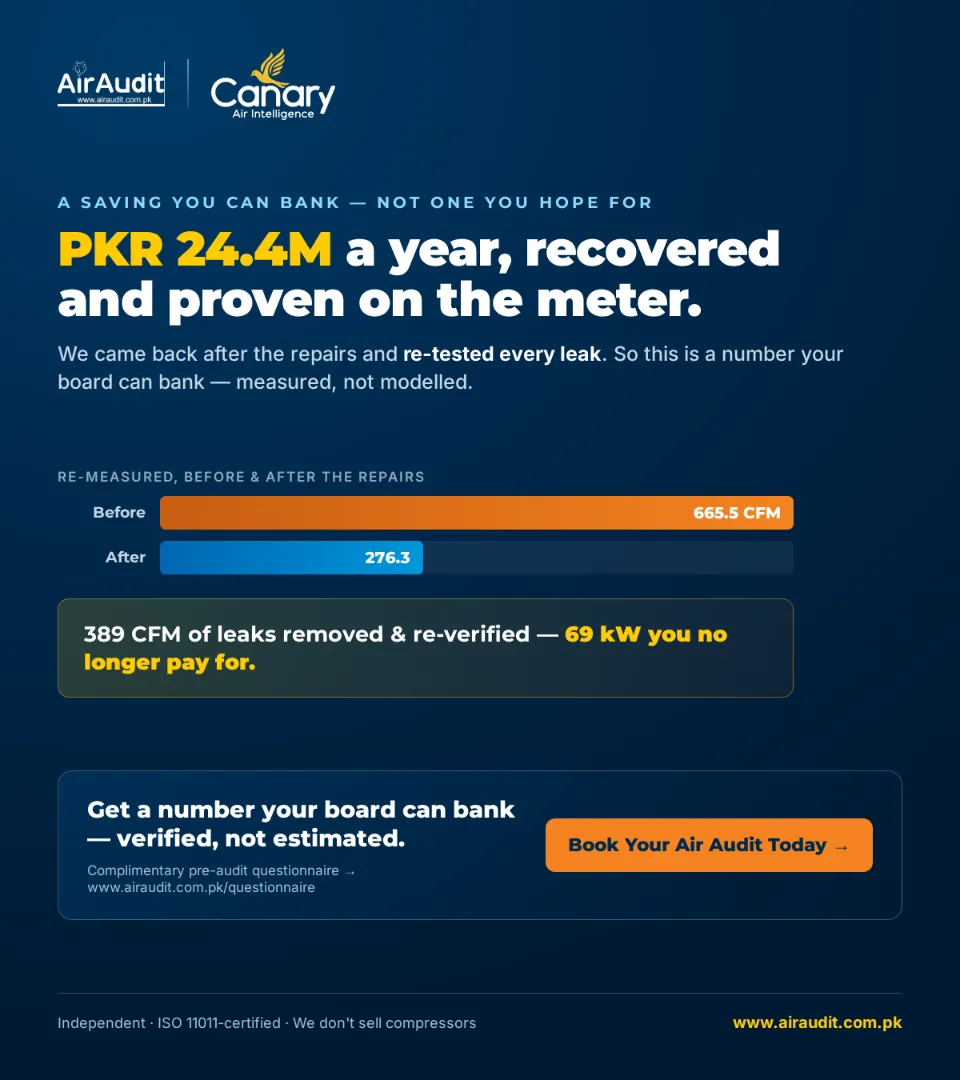
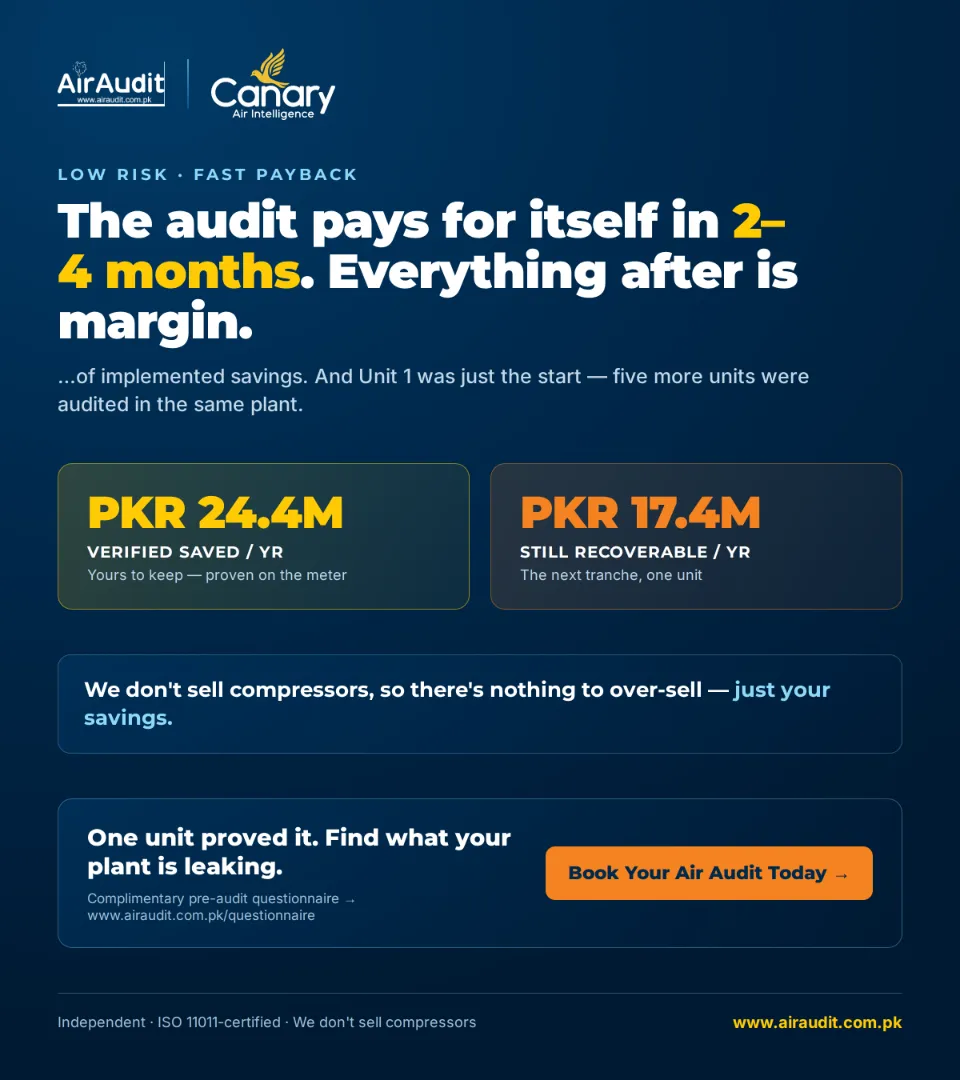
So we returned and re-tested. The maintenance team had plugged the leaks accounting for 389 CFM of the loss. On re-measurement, the recovered flow translated to 69.0 kW of compressor load that no longer had to run — a verified saving of PKR 24.4 million per year, confirmed on the meter, not estimated on a spreadsheet.
What we didn’t hide
Verification cuts both ways. When you go back and measure, you also see what’s still leaking — and we report it. 276 CFM remained unplugged, roughly 49.1 kW, or PKR 17.4 million a year still escaping from that same unit.
We could have left this out and headlined a bigger, rounder number. We don’t, because the value of an independent audit is that the figures survive scrutiny. That remaining PKR 17.4M is not a failure — it’s the next tranche of recoverable savings, waiting for a second round of repairs and re-verification.
Why “verified” is the whole point
An unverified saving is an opinion. A verified saving is an asset — something a plant engineer can take to the board, an ESG report can carry as a real Scope 2 reduction on compressed air, and a CFO can bank. The gap between the two is enormous, and it is where most “energy savings” quietly disappear.
Our method is built to close that gap:
- We measure the baseline with calibrated instruments, not nameplate assumptions.
- We tag and quantify every leak, department by department.
- We return after repairs and re-test — so the final number is what the meter says, not what the model predicted.
And because we don’t sell hardware, there is no incentive on our side to inflate a finding or steer you toward a purchase. The number is the number.
What this means for your plant
If a single unit in one mill was leaking PKR 41.9M a year, the question isn’t whether your plant has the same problem — it almost certainly does. The question is how much of it you can see, and how much of it you can prove.
For most of our clients, the audit fee is recovered within two to four months of implementing the savings we identify. After that, every rupee is retained margin — and with our co-brand monitoring platform, Canary Air Intelligence (www.canary-air.com), those savings can be tracked live so leakage never quietly creeps back.
Start with our complimentary pre-audit questionnaire — it takes a few minutes and tells us (and you) where the likely losses sit: www.airaudit.com.pk/questionnaire
Or Estimate your Compressed Air Savings by yourself https://airaudit.com.pk/airaudit-savings-estimator/
Book Your Air Audit Today — www.airaudit.com.pk
AirAudit — independent, hardware-neutral, ISO 11011-certified compressed air auditing. We do not sell compressors and do not represent compressor companies.